



Cellulite or lipedema? What’s really happening beneath the skin
Most women are familiar with dimples on their thighs, buttocks, and hips. The characteristic “orange-peel skin” is especially visible when the skin is pinched. But when is it simply cellulite—and when might changes in the subcutaneous fat tissue be related to lipedema?
At first glance, cellulite and lipedema can look similar. But different processes are happening beneath the skin.
What is cellulite?
Cellulite is not a disease, but a very common change in the appearance of the skin. Estimates suggest that around 80 to 90 percent of women develop at least some cellulite after puberty.
It can affect women who are very slim as well as those with fuller figures, and initially says little about body weight or physical fitness.
One factor behind its development is the structure of our subcutaneous fat tissue.
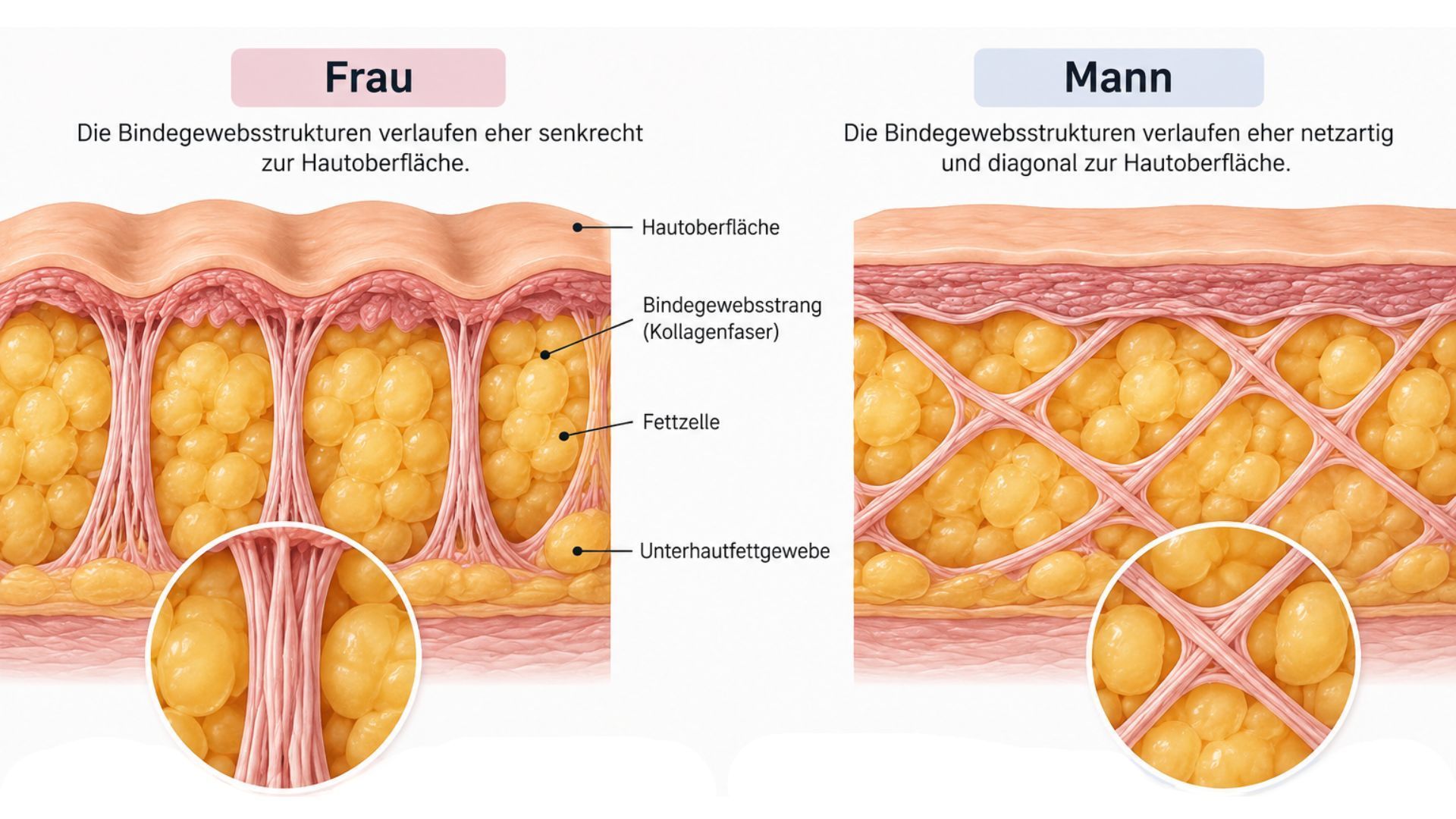
Beneath the skin are fat cells arranged in fat lobules and separated by connective tissue structures. These collagen-containing structures connect deeper layers of tissue to the skin.
In women, these connective tissue septa tend to run more vertically to the skin’s surface. As the fat tissue between these structures grows, it can bulge upward against the skin. At the same time, the connective tissue bands pull certain areas of the skin downward.
This creates the characteristic dimples known as orange-peel skin.
Why are women more likely to have cellulite than men?
Men also have subcutaneous fat tissue. However, the structure of their connective tissue is different.
In men, the connective tissue structures in the subcutaneous fat tissue are more often strongly interconnected and run diagonally or in a crisscross pattern. This divides the fat tissue differently and makes it less likely to bulge toward the skin’s surface between individual connective tissue structures.
That’s one reason cellulite is much less noticeable in men.
Hormonal and genetic factors also play a role, along with age, skin thickness, and the individual distribution of fat tissue.
Cellulite is therefore not automatically a sign that someone weighs too much or doesn’t exercise enough.
Cellulite and lipedema can occur at the same time
One important point is often overlooked: cellulite and lipedema are not mutually exclusive.
A woman with lipedema can also have completely normal cellulite.
Visible dimples on the skin alone are therefore not a reliable way to identify lipedema. Conversely, smooth skin does not automatically mean that lipedema is absent.
The overall picture is always decisive in making a diagnosis.
Can you tell cellulite and lipedema apart by appearance?
Not reliably.
Photos on social media can quickly lead women to compare their legs with supposedly “typical lipedema legs.” However, this can be misleading.
In addition to fat distribution, a medical assessment also considers symptoms, medical history, and a physical examination.
Other causes of changes or swelling in the legs must also be considered.
That’s why lipedema should not be diagnosed based solely on photos, dimples, or certain body proportions.
Why does cellulite often become more noticeable with age?
Connective tissue also changes over the course of our lives.
As we age, the skin loses elasticity and firmness. Fat distribution and tissue structure can also change. As a result, unevenness in the underlying fat tissue can become more visible on the skin’s surface.
However, the severity of cellulite depends on many factors—including genetics, hormones, skin texture, and individual fat distribution.
That’s why two women with a similar body weight can have completely different skin texture.
Does cellulite mean something is wrong with my body?
No.
Cellulite is extremely common in women and is initially a normal anatomical feature. It is not a disease and does not need to be treated for medical reasons.
It’s a different story when additional symptoms occur.
For example, if your legs regularly hurt, are very tender to pressure, feel persistently heavy, or you bruise especially easily for no apparent reason, you should have the cause checked by a doctor.
These symptoms do not prove that you have lipedema, but they may warrant further examination.
Cellulite or lipedema: the key difference
Put simply, the difference can be summed up as follows:
With cellulite, the main focus is the structure of the skin’s surface. Fat tissue and connective tissue structures create the characteristic dimples. It is a very common cosmetic skin concern, not a disease.
Lipedema, on the other hand, is a chronic disease of the subcutaneous fat tissue. What matters, then, is not individual dimples, but especially the characteristic pattern of fat distribution together with related symptoms.
So if you notice cellulite when looking at your legs, there’s no need to worry at first.
However, if visible changes are accompanied by pain, tenderness to pressure, a feeling of heaviness, or an unusual tendency to bruise, a medical examination may be worthwhile.
Cellulite and lipedema can sometimes look similar on the outside—but what matters is what is actually happening beneath the skin.